Saturday, October 22, 2011


Saturday, October 15, 2011
Saturday, October 8, 2011
Cool Stuff Posted to Diigo This Week (weekly)
-
The Innovative Educator: Seth Godin Discusses Failure of Educational Model
-
TeachPaperless: Essential Anthology of 21st Century Education Blogs
-
Are U Ready To Make Twitter Chats part of SocMedia Strategy? | Social Media Explorer
-
Steve Jobs Legacy In the Pantheon of Great American Innovators
-
Organize your resources in an online binder - LiveBinders
-
Free Technology for Teachers: PBS Teachers Research & Best Practices
-
The Innovative Educator: 20 Things a Teacher Wants the Nation to Know About Education
Saturday, September 10, 2011
Cool Stuff Posted to Diigo This Week (weekly)
-
I Believe… Don’t. Do. (Internet Safety, Part 2)
explains why kids (most likely older kids -high schoolers) should use their own names when "building an online presence" and not being anonymous.
Saturday, September 3, 2011
Cool Stuff Posted to Diigo This Week (weekly)
-
This article helps you share your blog w/ the Twitter-verse through the hashtag #ebshare.
Saturday, August 27, 2011
Cool Stuff Posted to Diigo This Week (weekly)
-
Xerox PARC, Apple, and the Creation of the Mouse : The New Yorker
-
You Tube Video on How to Make a Tiny URL
While learning 21st CTL at Marysville today (8.25.11), I worked on Camtasia Studio 7 put on by Mark Repp, tech trainer for Port Huron Area School District. Mark loaned us headset microphones and also taught us how to use a website called TinyURL.com.
-
TinyURL.com - shorten that long URL into a tiny URL
How to shrink superlong urls. Hence, the name tinyurl.com
-
Learning how to use Camtasia through tutorials.
-
Handouts from Port Huron techie guy who taught us about Camtasia.
-
News: What Students Don't Know - Inside Higher Ed
-
At Illinois Wesleyan University, “The majority of students -- of all levels -- exhibited significant difficulties that ranged across nearly every aspect of the search process,” according to researchers there. They tended to overuse Google and misuse scholarly databases. They preferred simple database searches to other methods of discovery, but generally exhibited “a lack of understanding of search logic” that often foiled their attempts to find good sources.
- Librarians and professors are also partially to blame for the gulf that has opened between students and the library employees who are supposed to help them,
- Some professors make similar assumptions, and fail to require that their students visit with a librarian before embarking on research projects
- : students were not very good at using Google. They were basically clueless about the logic underlying how the search engine organizes and displays its results.
-
-
How to Write Effective Driving Questions for Project-Based Learning | Edutopia
-
Interview with author Joseph Ellis who had written American Sphinx about Thomas Jefferson.
-
Looks at the military aspects of the Whiskey Rebellion in 1794.
-
Website for PBS' show Colonial House. Check it out!
-
Shays' Rebellion - From Revolution to Constitution
Examines why Shays' rebellion helped push the country towards the Constitution and exposed the weaknesses of the Articles of the Confederation.
-
How to use Diigo and its applications.
-
Urls on Google on how to use Diigo.
-
Grunge nostalgia: Why we should let Kurt Cobain rest in peace. - By Simon Reynolds - Slate Magazine
-
Cool Cat Teacher Blog: Tips for Teaching Wikis: How I explain it to students
-
-
-
-
-
Highly Educated Useless People (from “guest blogger” – Ian Jukes) « allthingslearning
-
http://smithsonianeducation.org/scitech/carbons/images/xerox914-lg.gif
-
-
-
-
http://smithsonianeducation.org/scitech/carbons/images/brother-lg.gif
-
-
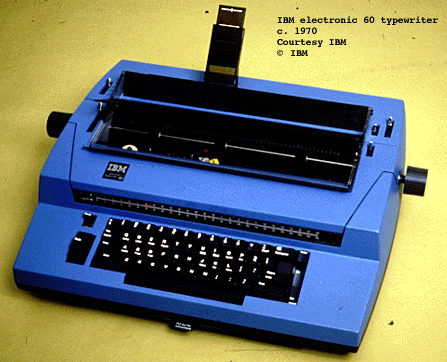
http://smithsonianeducation.org/scitech/carbons/images/ibmblue-lg.gif
-
-
http://smithsonianeducation.org/scitech/carbons/images/royal-lg.gif
-


Monday, August 22, 2011
Interview with my mom, Pt. 1
"Our progress as a nation can be no swifter than our progress in education. The human mind is our fundamental resource" - John F. Kennedy
I have had the pleasant opportunity to spend some time talking with my mother the last few days. Our conversations range all over the place, from family to politics and education (two topics we agree on) to fantasy football and opera. Really.
 When my mother first began studying at Highland Park Junior College in the mid 1950s, she learned clerking and typing skills on a manual typewriter. Even before that, at St. Ladislaus High School, the nun played "Onward Christian Soldiers" to develop the students' rhythm as they typed. At HPJC, she learned how to use business machines, grammar, "bookkeeping" as she says or accounting as we now call it. Her economics' instructor had a mole on the tip of her tongue that distracted my mother's attention from lessons on supply and demand, but she still retained the info. A "dreadfully" boring English class that had nothing but essays also filled her time. The coordinator of the secretary's program was a "petite" woman who was always properly dressed with white gloves and interviewed the interns who would then go to work at Dodge Main in Hamtramck, MI.
 "All progress is precarious, and the solution of one problem brings us face to face with another problem" - Rev. Dr. Martin Luther King, jr.
No sooner had Sputnik hit the stratosphere than Americans became obsessed with progress. Critics pointed to a lack of progress in American schools. So, millions was spent to improve our kids' education in science and math because we had obviously fallen behind in the space race which was just one more facet of the Cold War.
My mother and father were married in 1959, but not before my mother was transferred to Chrysler Missile division in Sterling Heights, MI. The town lacked the strip malls and six lane roads that crisscross it today because back then it was just farm country. At Chrysler Missile, my mother upgraded her technology by switching to the state-of-the-art Electric Typewriter! Security was so tight at the plant that all the waste paper baskets had locked covers w/ slits on top in which to slide paper into the baskets so that the Communist spies lurking around every corner wouldn't pilfer company secrets. However, after the machines emptied the trash cans at the end of the day, the paper was available to any passersby who happened to look into the uncovered garbage bins out back.

Drawbacks with the new upgrade: expensive? Sure. Was it justified once you looked at increased productivity? Not sure. My mom doesn't remember being able to type any faster until she got a newer upgrade: the IBM Selectric.
This machine is probably most well-known for its swiveling ball head (see below on left). My mother felt that this new typewriter made her more productive because not only did it prevent any jamming of the letter hammers but it also had correction tape that removed a mistake (though beneath the carbons the mistake was still there). Additionally, each of the Selectric swivel heads could be adjusted with another one to adjust the font style and size.

She went to work with Grant Advertising (probably through her connections at Dodge Advertising) and then Difco Pharmaceuticals for five years making about $500 / month between 1960-65 ($3,700 in 1960 and $3,500 by 1965 - all in 2011 dollars). She started out working on their catalogue that highlighted their latest medical lab equipment. During the early 1960s, she acquired special training on the first Xerox machines (below right). This was a huge time saver because it eliminated the need for carbon paper. However, one of the defects of the early Xerox machines was that it "scorched" the papers it was copying.
 At Difco, she also learned about perpetual inventories, a card filing system made by IBM that helped companies maintain a record of their inventories and when to order it without an expensive computer.
 Sunday, August 14, 2011
Shameless self-promotion

http://www.theinspiredclassroom.com/2011/08/a-pd-retreat/
On Twitter a couple of nights ago, Elizabeth Peterson of The Inspired Classroom asked for her Twitter followers to answer the question: "What do you think of when you hear the words 'professional development'?" My quote is in the article:
"@eliza_peterson Depends - sometimes it's painfully boring meetings. Othertimes it can be productive if I can find uses for it in my clssrm"
And it seems that all of the respondents are on the same page - teacher-centered PD is much more fulfilling than something that doesn't appear to apply to our classrooms. In some instances, teachers can be the worst students b/c if he doesn't see a need or use for what is being presented to him (I'll use myself as an example), the teacher can switch to "multi-tasking" mode which means really only paying 1/2 to 1/3 attention to the presenter. A teacher's time tends to be so crunched with so many different priorities - lesson planning, grading papers, additional meetings, copying, not to mention anything that the teacher's regular life might demand after school is over - that like a small deck of playing cards, the PD that he is not finding stimulating goes to the bottom of the deck while the next card gets dealt. Or, whatever is higher on the priority list gets done, or if he's planned ahead and brought work to do at the PD, then the time crunch gets eased.
This myth that the teachers' work day ends when the kids' day ends is erroneous. If kids have homework, what makes rational adults think that teachers don't have some kind of work to get ready for the next day, week or month? Some teachers may just do the bare minimum, but most do not. They push themselves and push their kids. And the best teachers treat their work like it is a craft. To quote Elizabeth, "Teaching is an art form in and of itself and to get better at it we need to constantly learn and grow."
To do less than give it your best is to discredit yourself, the profession, and the students.
Wednesday, August 10, 2011
Working with Google Docs - Survey and Spreadsheet
I had never really worked with Google Docs before in a classroom setting but I was intrigued at the possibilities of applying them to my Advanced Placement U.S. History (APUSH) classes. I was looking for a way to maximize my time and energy and speed up my feedback time for my students, which if you ask them, can be glacial at times.

I first tried blogs as a replacement for writing journals in 2005 and 2006 and have students email their homework to lessen the paper load probably as early as 2000. I feel the proudest of the blogs because they have continually evolved over the years from me asking questions to the students asking questions about what we were studying at the time. As the blogs capabilities grew, I was able to embed links and videos that the students could use to extend their learning beyond the classroom (the blog?). I liked that I could give the students quick feedback on their blogs instead of grading their writing journals once or twice a semester. As an added bonus, I didn't have to cart 40-60 notebooks home (and snag the dangling spiral spool on various clothing items).
So, it is in this same spirit (less paperwork + quicker feedback) that I decided to try out a few Google doc assignments. I was lucky enough to attend the Building Learning Communities 2011 Conference in Boston last month, and on the 2nd day, I tried out a Google survey while working in Lisa Thumann's session, "Using Google Apps for Global Connections." I wanted to see how far my APUSH students were in their summer reading and what they thought of the book, Mayflower by Nathaniel Philbrick, so far. Lisa had just walked us through how to do this kind of survey, so I put one together, sent them a Tweet that there was a survey (more on Twitter a later post) and asked them to complete it. As students checked the blog for Mayflower study questions, they saw the survey and I got some really interesting responses:
Students ahead of where they were supposed to be: 6
Students at the assigned place: 13
Students who admitted to being behind: 8
Students who hadn't answered yet: 26 (sad, I know)
Pros: "[Reading] it kills time when there's nothing to do."
"It's written almost like a novel."
"It's informative and not totally dull as dirt."
"The author connects places, people and situations to more modern and well known examples."
"It's a good deal more interesting than a textbook and helps me learn more than just names and dates."
"It's not a textbook."
"It actually keeps me interested when I'm reading it. The problem is, they use huge words that I don't understand and I have to use the dictionary. Pain in the butt."
* This last statement solidified my desire to use a Google Spreadhseet for part of their summer homework assignment where they would find seven difficult words, define them as they were used in the book, and cite the page number where the word was found (see screen shot below).

"It's summer and I have to do homework for this book in a few days."
"The book seems to drag on for me. It feels like it's never going to end. No offense."
"A good portion of this book was dreadfully boring. I enjoyed it from an educational standpoint, but that didn't make it any easier to read."
"At the beginning I had 50 different characters being thrown at me."
"Because I have to read it for school it is instantly 17.2% less fun than it would have been if i read it on my own time and of my own free will."
Reflections: I love these comments b/c they will force me to eventually rethink what I am doing with summer reading (and, if I continue to survey them in a similar fashion, I can use their feedback to adjust other assignments throughout the year). However, since these guys are honors sophomores turning juniors this September (I've already had them for 2 trimesters, so they feel comfortable sharing their opinions with me), and their reading is relatively unguided (except by some study questions that I have written for them), I hope that they will see the value of reading the book after we go over the settlement of New England within the first couple weeks of class.
I have told my students that the vocab list that they are creating will help next year's APUSH students more than it will help themselves. I knew going into this assignment that the vocabulary would be difficult, but I think the spreadsheet is just a start for my class.
Please leave some feedback. It is much appreciated.